
This article originally appeared in the Jewish press and has been adapted for web
A fascinating question arose in a local minyan on Purim that touches on two important areas of the halachos of STaM: חק תוכות (chok tochos), forming a letter through erasure, and מחיקת השם (mechikas Hashem), the prohibition against erasing Hashem’s Name.
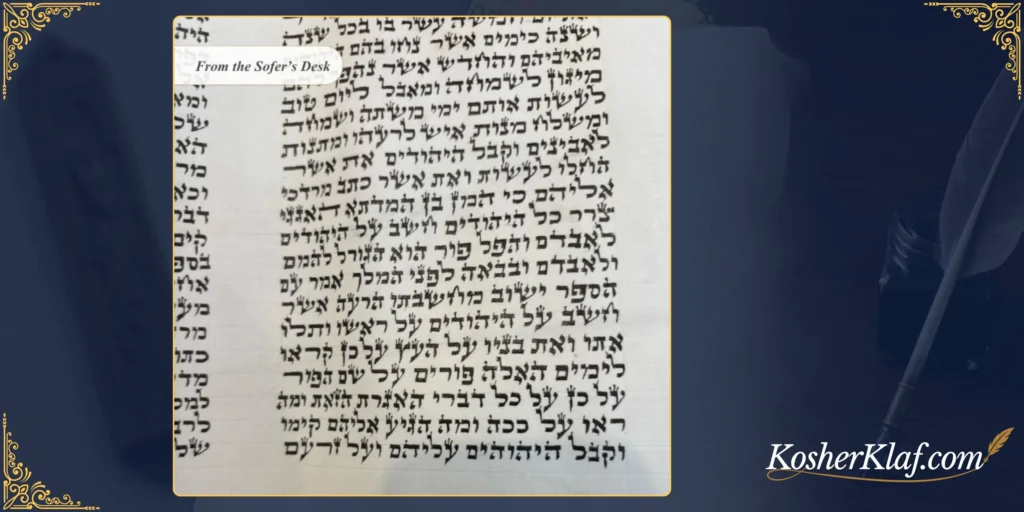
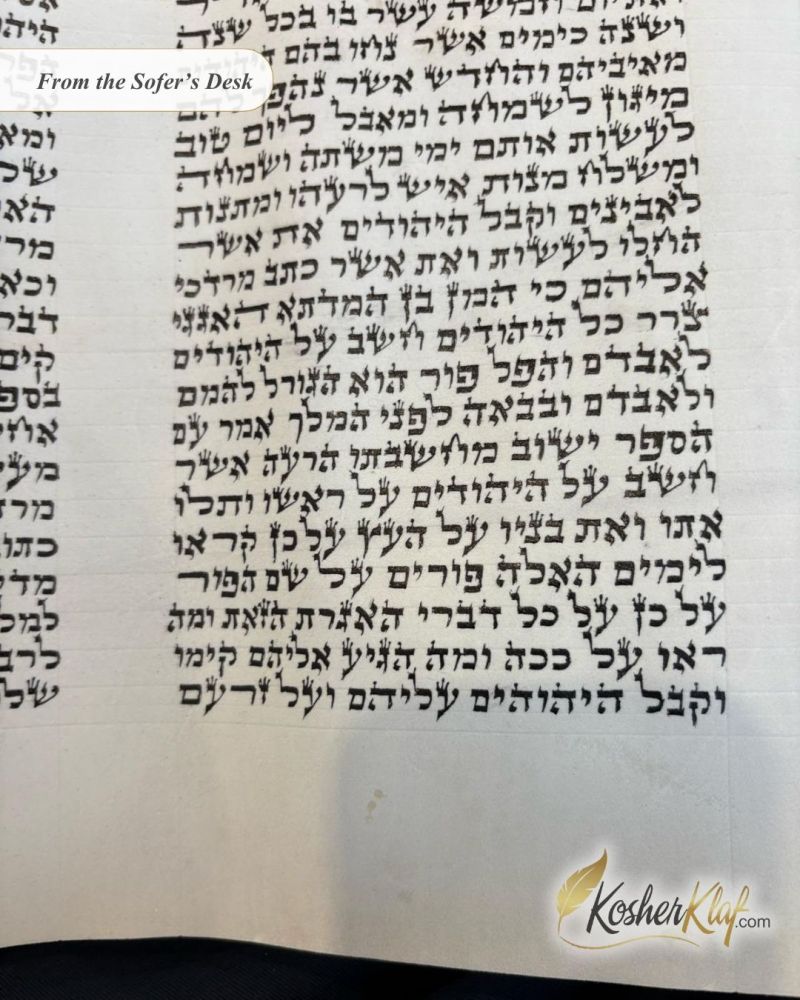
During the reading of the Megillah, an error was discovered in the final line. Instead of the word היהודים (haYehudim), “the Jews,” the word had been written היהוהים (haYehohim).
In other words, where there should have been a ד (daled), the sofer had written a ה (hei).
Someone in the minyan suggested what seemed like a very simple solution. Why not erase the small left leg at the bottom of the ה (hei)? Once that extra piece of ink was removed, what remained would look like the correct ד (daled).
Visually, it seems like the easiest possible correction.
Halachically, however, it raises a significant problem.
The Problem of חק תוכות (Chok Tochos)
One of the fundamental rules of STaM is that a letter must be created through an act of writing. You cannot create the required letter simply by removing ink until the correct shape remains.
This principle is known as חק תוכות (chok tochos).
The Shulchan Aruch discusses this principle in the laws of Tefillin. If ink falls into a letter and destroys its proper form, the sofer cannot simply scrape away the excess ink in a manner that causes the valid letter to emerge through the erasure. The required letter must be produced through an act of writing, not by removing ink.
See Shulchan Aruch, Orach Chaim 32:17 on Sefaria.
This distinction is critical. The question is not merely what the letter looks like when the correction is finished. We also have to ask: How did this letter become a valid letter?
If it became a valid letter through writing, that is one thing. If the required shape only came into existence because ink was removed, that can constitute חק תוכות (chok tochos).
The broader requirement that the letters of STaM be properly formed is expressed by Chazal as וכתבתם שתהא כתיבה תמה (u’chesavtam shetehei kesivah tamah), that the writing must be complete and proper. The Gemara discusses this requirement and the proper distinction between the different Hebrew letters in Shabbos 103b–104a.
See Shabbos 103b–104a on Sefaria.
Applying This to Our Megillah
That brings us back to the Megillah.
The sofer needed to write:
היהודים (haYehudim)
Instead, he wrote:
היהוהים (haYehohim)
At the relevant point, there was a ה (hei) where there should have been a ד (daled).
If we simply erase the lower left leg of the ה (hei), the letter remaining on the parchment will look like a ד (daled).
But what actually created that ד (daled)?
The erasure did.
Before anything was erased, the letter was a ה (hei). Only after removing the ink did it become a ד (daled).
That is exactly where the concern of חק תוכות (chok tochos) arises. The required letter was not formed through writing; it was created by removing part of a different letter.
This is an excellent example of why STaM corrections are often more complicated than they appear. A correction can look perfect when it is finished and nevertheless have a halachic problem because of the method through which the letter was created.
But Wait: Are We Erasing Hashem’s Name?
After we originally discussed this case, a number of people raised another interesting question.
Look again at the mistaken word:
היהוהים (haYehohim)
It appears to contain letters associated with Hashem’s Name.
If we are talking about erasing part of this word, does that create an entirely different problem of מחיקת השם (mechikas Hashem), erasing Hashem’s Holy Name?
The prohibition against erasing Hashem’s Name is derived from the Torah’s command not to do to Hashem what we are commanded to do to idolatry: לא תעשון כן לה’ אלהיכם (lo sa’asun kein laHashem Elokeichem), “You shall not do so to Hashem your God.”
The Rambam codifies this prohibition in Hilchos Yesodei HaTorah 6:1, explaining that one who destroys one of Hashem’s sacred Names violates a Torah prohibition. He then enumerates the Names that have this special status.
See Rambam, Hilchos Yesodei HaTorah 6:1–2 on Sefaria.
The Gemara discusses which Names may and may not be erased in Shevuos 35a–35b.
See Shevuos 35a–35b on Sefaria.
The Shulchan Aruch codifies these laws as well, ruling that it is forbidden to erase even one letter of the seven Divine Names that may not be erased.
See Shulchan Aruch, Yoreh De’ah 276:4 on Sefaria.
So does the accidental appearance of these letters inside היהוהים (haYehohim) create a problem?
A Divine Name Inside Another Word
The appearance of letters that can spell or form part of one of Hashem’s Names does not automatically give those letters the status of a שם קודש (Shem Kodesh).
The halachic status depends on what was actually written. Hebrew contains ordinary words and personal names that include letter combinations that can also appear in Hashem’s Names. That does not mean that every such sequence becomes an independent Divine Name.
The Rambam himself discusses distinctions between an actual Divine Name and letters that are attached to it. For example, letters placed before a Divine Name may be erased, while letters attached afterward acquire a greater degree of sanctity.
See Rambam, Hilchos Yesodei HaTorah 6:2 on Sefaria.
This demonstrates an important principle: the laws of מחיקת השם (mechikas Hashem) are determined by the halachic identity of what was written, not merely by finding a familiar sequence of letters somewhere within a larger word.
The Sofer’s כוונה (Kavanah)
There is another important element in our case: the כוונה (kavanah), or intention, of the sofer.
When a sofer writes Hashem’s Name in STaM, it requires special intention. The Shulchan Aruch rules that when writing a Divine Name, the sofer must sanctify it as Hashem’s Name.
See Shulchan Aruch, Yoreh De’ah 276:2 on Sefaria.
The Rambam similarly discusses the special status required when a sofer writes Hashem’s Name in a Sefer Torah.
See Rambam, Hilchos Tefillin, Mezuzah and Sefer Torah 1:15 on Sefaria.
In our case, the sofer was never attempting to write Hashem’s Name. He intended to write:
היהודים (haYehudim)
He was writing the word “the Jews.” The ה (hei) appearing in place of the ד (daled) was simply a scribal error.
Therefore, we are not dealing with a sofer who deliberately wrote one of Hashem’s Names and then wants to erase it. We are dealing with an accidental combination of letters that appeared while the sofer was attempting to write an entirely different word.
The precise laws of a Divine Name written without the proper כוונה (kavanah) have additional details and should not be reduced to a blanket rule that anything written without kavanah may automatically be erased. But in our particular case, the intended word and context make clear that the sofer was not writing a Divine Name at all.
One Tiny Stroke, Two Completely Different Questions
What makes this case particularly interesting is that a tiny piece of ink raises two entirely different halachic questions.
The first question is whether removing the leg of the ה (hei) constitutes מחיקת השם (mechikas Hashem), erasing Hashem’s Name.
Here, the letters appeared accidentally as part of an erroneous word. The sofer was attempting to write היהודים (haYehudim), not a שם קודש (Shem Kodesh).
The second question is whether removing that same piece of ink can validly transform the ה (hei) into the required ד (daled).
Here we encounter חק תוכות (chok tochos). Since the ד (daled) would acquire its identity through the removal of ink rather than through an act of writing, simply erasing the extra stroke presents a halachic problem.
STaM Is About More Than the Finished Product
When most people look at a Sefer Torah, Tefillin, Mezuzah, or Megillah, they naturally focus on the finished letters.
Does the letter look right?
Is everything spelled correctly?
Is the writing beautiful?
But the halachos of STaM go much deeper than appearance.
Halachah is also concerned with how the letter came into existence.
A letter that looks beautiful may nevertheless be invalid if it was created improperly. Conversely, a correction that appears incredibly simple may require significant knowledge to perform correctly.
That is why STaM repairs should be performed by a qualified סופר (sofer) who understands not only the shapes of the letters, but also the halachos governing their formation and correction.
Sometimes the difference between a valid correction and an invalid one is no more than a tiny stroke of ink.
Yet, as this Purim Megillah demonstrated, that tiny stroke can open the door to an entire discussion in halachah.
Shulchan Aruch, Orach Chaim 32:17 — Chok Tochos
https://www.sefaria.org/Shulchan_Arukh%2C_Orach_Chayim.32.17
Shabbos 103b — Kesivah Tamah / formation of letters
https://www.sefaria.org/Shabbat.103b
Shabbos 104a
https://www.sefaria.org/Shabbat.104a
Shevuos 35a — Names of Hashem that may not be erased
https://www.sefaria.org/Shevuot.35a
Shevuos 35b
https://www.sefaria.org/Shevuot.35b
Rambam, Hilchos Yesodei HaTorah 6:1 — Erasing Hashem’s Name
https://www.sefaria.org/Mishneh_Torah%2C_Foundations_of_the_Torah.6.1
Rambam, Hilchos Yesodei HaTorah 6:2 — Names that may not be erased
https://www.sefaria.org/Mishneh_Torah%2C_Foundations_of_the_Torah.6.2
Shulchan Aruch, Yoreh De’ah 276:2 — Kavanah when writing Hashem’s Name
https://www.sefaria.org/Shulchan_Arukh%2C_Yoreh_De%27ah.276.2
Shulchan Aruch, Yoreh De’ah 276:4 — Erasing Hashem’s Name
https://www.sefaria.org/Shulchan_Arukh%2C_Yoreh_De%27ah.276.4